Sports Franchises as Infrastructure-Like Assets
What Arctos' Model Signals for Long-Term Capital
Introduction: Sports Teams as the New "Real Assets"
For decades, owning a sports franchise was often seen as a trophy or community endeavour as opposed to an investment. Sports teams have emerged as distinct and lucrative asset classes, characterised by their stable revenue streams, strong market positioning, and a rapidly growing global fan base. The global sports industry is projected to reach $967 billion by 2027, growing at a CAGR of 5.2%, while franchise valuations have grown 11% year-on-year, despite wider market uncertainty (Klutch Sports Group & RBC, 2024). The scale of the industry reinforces the investment logic behind such acquisitions.
According to Deloitte’s 2025 Sports Investment Outlook, football has held its position as the leading target for investment in 2024, accounting for fully 50% of all sports rightsholder M&A transactions that year. Within those deals, 16% were concentrated in Europe’s elite “Big Five” leagues (the Premier League, Bundesliga, La Liga, Serie A, and Ligue 1) - emphasising that top-tier franchises command a premium. At the same time, investors are broadening their scope: motorsport, for example, saw its share of deal volume double to 8% of all sports deals in 2024 (up from 4% in 2023) (Deloitte, 2025). While traditional sports continue to dominate deal volumes, investors are increasingly targeting emerging, high-growth properties with compelling commercial upside.
Arctos' Model: Opening the Doors for Institutional Capital
The evolution from trophy ownership to institutional investment is held in the strategy of Arctos Sports Partners. The specialised private investment firm, founded in 2019, focuses on providing growth capital and liquidity to leading sports franchises and adjacent businesses globally, uniquely approved to invest across all five major North American leagues (NFL, NBA, MLB, NHL, MLS) and major European soccer.
Arctos’ strategy is founded in the belief that professional sports franchises are scarce, long-term assets capable of delivering stable, recurring income - making them ideal for long-term capital strategies aimed at compounding value over extended periods. In addition, sports ownership typically has displayed low leverage and little correlation across market and economic cycles. These assets prove to be extremely resilient in the face of macro-shocks such as the COVID-19 pandemic in which sports were not being played in 2020 and 2021, yet revenues never dropped below 85 percent of pre-pandemic levels (PEI, 2024). Arctos’ model has demonstrated that a portfolio-based approach to sports ownership is a viable long-term strategy for pension funds and endowments, similar to investing in infrastructure such as utilities, ports, or commercial real estate.
One of Arctos’ most significant contributions has been to legitimise sports franchises as an asset class with measurable performance. In collaboration with the University of Michigan’s Ross School of Business, Arctos helped develop the Ross-Arctos Sports Franchise Index (RASFI) to track the investment performance of North American sports franchises since 1962. The findings show that sports franchises consistently outperform traditional asset classes such as equities, bonds, and commodities over the long run, whilst delivering steady returns with low volatility.
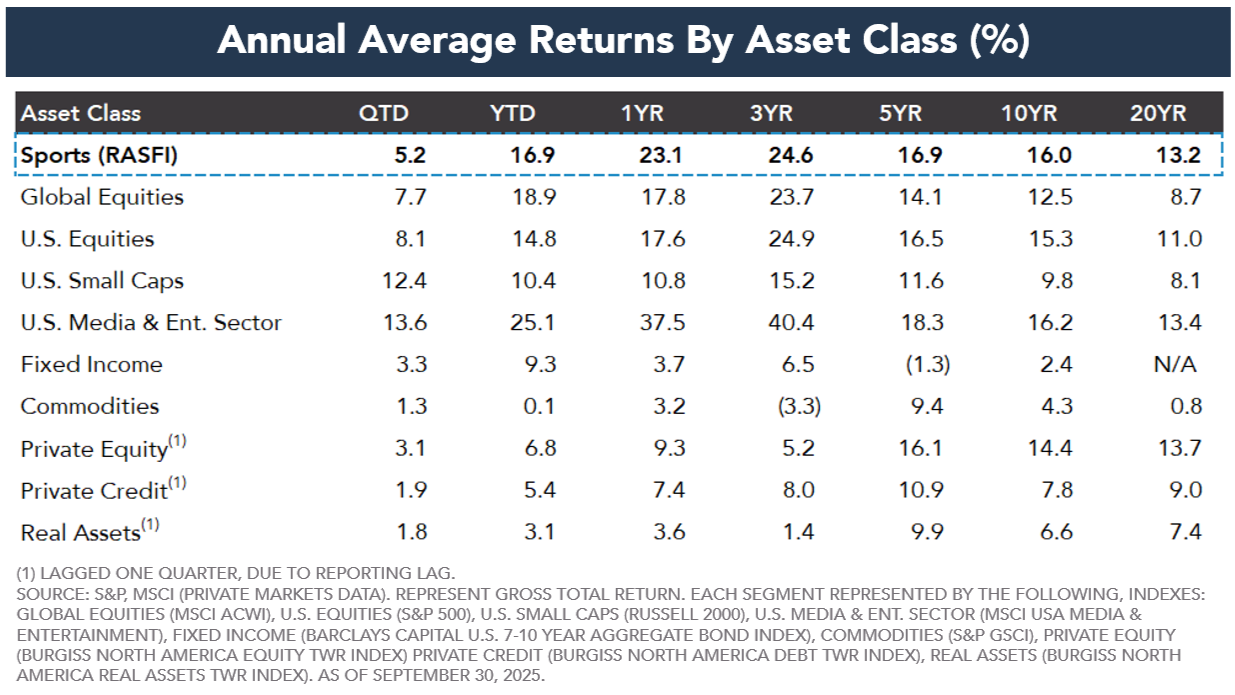
(Arctos Partners, 2025)
While traditional revenues like media rights have matured, Arctos and other funds increasingly focus on real estate development and sports-anchored mixed-use districts (SMDs) as next-generation value drivers. These assets generate returns from mixed-use infrastructure including retail, hospitality, and residential. Revenues from these are fully retained by owners, unlike shared league media rights.
Infrastructure-Like Characteristics of Sports Franchises
The investment thesis for sports franchises as infrastructure rests on several core characteristics, each of which mirrors elements of traditional long-duration, income-generating real assets.
- Scarcity and Stable Demand: Big-league sports teams are inherently scarce - there are only so many NFL, NBA, Premier League, or MLB franchises, and leagues tightly control expansion. This scarcity creates monopolistic positions in local markets. In addition, fanbases are extremely strong and often multi-generational, providing a steady base of demand for tickets, merchandise and media consumption.
- Long-Term, Recurring Revenues: Modern sports franchise benefit from multi-year media rights deals, sponsorships, and season ticket holder bases which generate predictable, recurring income. For example, national and regional TV contracts guarantee payments to teams on a regular schedule, similar to lease payments in a real estate investment.
- Protected and Resilient Business Model: Created through teams having local market exclusivity, protected by league territories (comparable to infrastructure projects, where you wouldn't typically build two rival bridges side by side). Salary caps or luxury taxes, revenue-sharing arrangements, and collective bargaining agreements help prevent runaway costs and ensure weaker teams can still survive.
- Growth Upside: Sports franchises have significant growth levers. Media rights values have been climbing for years as live sports becomes premium content for broadcasters and streaming platforms. New digital distribution channels, global fan base growth, and emerging segments like women’s sports and esports provide additional upside. Commercial innovations, such as legalised sports betting to direct-to-customer streaming, are creating new revenue streams for teams and leagues (Aranca, 2025). This is extremely appealing to private equity and other investors who seek not just stable cash flows but also the chance to compound capital over time.
- Tangible Assets and Real Estate Integration: Although a sports team’s brand is intangible, franchises are often underpinned by very tangible assets like stadiums, arenas, and training facilities. These venues can anchor broader real estate developments. Teams are increasingly pursuing sports-anchored mixed-use districts (SMDs), where a new stadium or arena is surrounded by retail, entertainment, hotels, and offices. The aim is to create year-round destinations that generate rental and commercial income beyond game days, enhancing franchise value.
In combination, these factors mean that a well-run sports franchise can behave like an infrastructure investment with an adrenaline kick: you get the stability of contracted revenues and protected market position, plus the excitement of growth from a globally beloved product.
Investing in Sports Infrastructure: The Crystal Palace Case
Sports franchise owners are increasingly exploring real estate-driven revenue streams as a way to diversify away from revenue-sharing constraints and complex bargaining agreements. These streams include stadium redevelopments and new construction projects designed to boost in-market revenues and elevate the fan experience. With the cost of sports venue development rising sharply - illustrated by the estimated $250 million upgrade of Levi’s Stadium for the 2026 Super Bowl - clubs are turning to equity and debt financing to fund major infrastructure investments (RBC Wealth Management, 2024).
Real estate assets lend “hard asset” characteristics to sports franchises, making their financial profiles more tangible. Ownership or long-term leasehold interest in a stadium can materially enhance a team’s asset base while enabling recurring, non-sport-related revenue through events, hospitality, retail, and entertainment offerings. As of 2024, at least 37 sports-anchored, mixed-use districts have been announced across major North American leagues alone, with an expected $100+ billion in capital investment opportunity over the next 15 years. These projects pair stadium upgrades with adjacent commercial, residential, and community development, creating recurring income and unlocking new valuation levers (Klutch Sports Group & RBC, 2024).
A clear example of infrastructure investment creating long-term franchise value is the planned redevelopment of Selhurst Park, home of Crystal Palace FC in London. The English Premier League club, with architectural design led by KSS Design Group, is undertaking a major expansion of its Main Stand, an ambitious project projected to cost between £75 - 100 million (Stadium Database, 2024). From an investment perspective, the redevelopment will increase capacity from 25,000 to over 34,000 seats, while adding premium hospitality facilities, improved accessibility, a club shop, museum, and cafés.
The project’s economics demonstrate the durability of sports infrastructure as a long-term investment. The new stand is expected to generate an additional £15 million in annual revenue, effectively paying for itself within 5 - 7 years. The design combines enhanced general admission capacity with approximately 2,500 premium seats and 16 - 28 private boxes, including a “tunnel club” VIP experience. By reinvesting in venue infrastructure, the club is positioning itself to unlock long-term, compounding revenues.
As Chairman Steve Parish put it, the vision is to deliver a stadium “fit for the 21st century” that reflects Crystal Palace’s ambitions and stands as a proud landmark for South London. Crystal Palace’s strategy exemplifies a broader global trend. Franchises across the sports industry are investing heavily in stadium and facility upgrades to secure long-term value and revenue growth. Recognising the strategic role of venue assets, private equity firms and institutional investors are increasingly financing these developments, either through lending or by acquiring equity stakes in teams. Firms like Arctos are explicitly raising capital to support such infrastructure-led growth (RBC Wealth Management, 2024).
Key Takeaways
- Franchise Value Is Rising: Sports teams have become a high-performing alternative asset class, outperforming traditional equities with stable, long-term returns.
- Arctos Set the Benchmark: By enabling institutional capital entry, Arctos redefined sports ownership as scalable and portfolio-friendly.
- SMDs Are the Growth Frontier: Sports-anchored mixed-use districts (SMDs) are unlocking real estate-driven revenues and significantly boosting valuations.
- Crystal Palace Is a Model: The Selhurst Park redevelopment shows how infrastructure investment can pay for itself within 5 - 7 years while future-proofing the brand.
5. The Real Asset Analogy Is Real: Scarcity, durable revenues, low correlation, and real estate integration position franchises like toll roads or airports - only with upside.
Closing Thoughts
The integration of sport, capital, and infrastructure signals a new era for institutional investors. Sports franchises now offer a compelling blend of stability and spectacle - delivering recurring revenues akin to infrastructure assets, but with the brand equity, cultural relevance, and emotional engagement that few other sectors can match. Yet, investors must remain clear-eyed. While the long-term fundamentals are robust, risks persist: poor on-field performance, player turnover, regulatory shifts, and changes in discretionary consumer spending can all impact financial outcomes.
As the sector matures, success will increasingly favour those who apply infrastructure-grade discipline - diversifying revenue streams, managing volatility, and aligning long-term capital with operational execution. In this space, as in sport, enduring performance requires not just passion, but precision.
Bibliography
Aranca (2024) Global Sports: Private Equity’s New Playground. [Online] Available at: https://www.aranca.com/reports/global-sports-private-equitys-new-playground
Arctos Partners (2025) Chart of the Week #87: RASFI Q3 2025 Update. LinkedIn, 30 October. Available at: https://www.linkedin.com/pulse/chart-week-87-rasfi-q3-2025-update-arctospartners-ha2mc
Crystal Palace F.C. (n.d.) Crystal Palace Main Stand Redevelopment. Available at: https://cpfc.co.uk/crystal-palace-main-stand-redevelopment/
Deloitte (2025) Deloitte’s 2025 Sports Investment Outlook: An overview of sports M&A trends and market activity. [Online]. Available at: https://www.deloitte.com/global/en/Industries/tmt/perspectives/deloitte-outlook-sports-investment.html
Klutch Sports Group and RBC (2024) Team Building: The Rise of Sports-Anchored, Mixed-Use Districts. [PDF] Available at: https://riseofsportsdistricts.com/klutch-white-paper.pdf
PEI Staff (2024) Arctos: The power of sports investing. Private Equity International, 3 June. Available at: https://www.privateequityinternational.com/arctos-the-power-of-sports-investing/
RBC Wealth Management (2024) Analysis reveals a rapidly growing investment trend in the sports industry. [Online] Available at: https://www.rbcwealthmanagement.com/en-us/insights/analysis-reveals-a-rapidly-growing-investment-trend-in-the-sports-industry
Skóra, P. (2024) England: Green light for Crystal Palace stadium redevelopment!, StadiumDB.com, 23 August. Available at: https://stadiumdb.com/news/2024/08/england_green_light_for_crystal_palace_stadium_redevelopment